
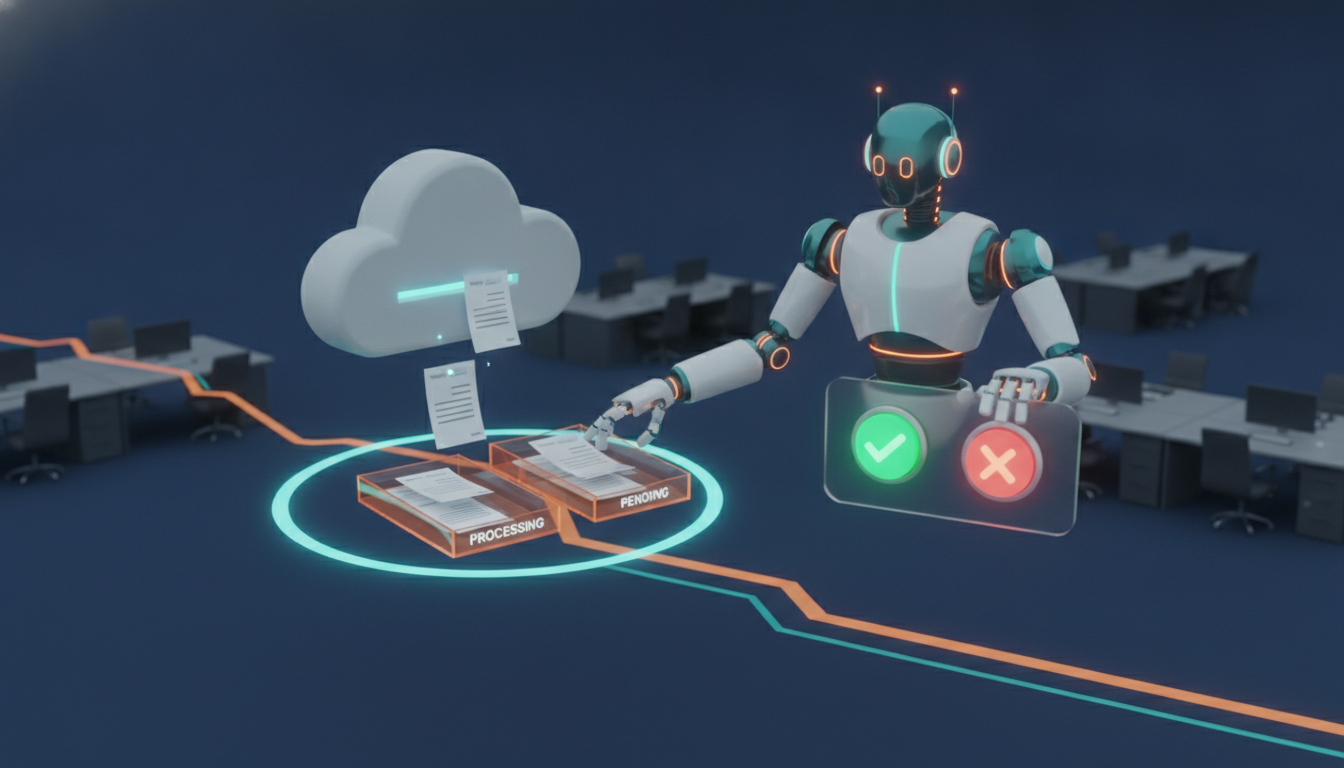
Chatbots wait for someone to ask a question. Ambient AI agents do not wait: they watch for business events, such as an invoice landing in a bucket, a contract being uploaded or a nightly report coming due, and start working on their own. AWS just published a reference architecture for building them on Amazon Bedrock AgentCore, and it answers the question most leaders actually care about: how do you let software act on its own without losing sleep over what it might do?
Why ambient AI agents beat another chatbot
The chat interface has a dirty secret: it only creates value when a human remembers to use it. Most of the repetitive judgment work in a company (categorizing expenses, triaging support attachments, checking a vendor document against policy) is triggered by an event, not by someone opening a chat window. Put an agent behind the event and the work starts the moment the input arrives, not when someone gets to it on Tuesday.
The AWS reference design frames this as Event, Signal, Agent, Human, Action. A “signal” is a rule a business user configures, for example “any PDF uploaded to the invoices folder goes to the accounts payable agent.” No engineering ticket required to add the next one.
The approval gate is the product
Here is the part vendors tend to skip. Autonomy is not a feature you sell to a CFO. Controlled autonomy is. The reference build gives you two dials that make agents acceptable to risk owners:
- Review before run. Each signal has an auto-execute switch. Off, and every triggered job waits in an idle queue until a person clicks Execute. On, and it runs immediately. You can start every new workflow in review mode and promote it once you trust it.
- Pause mid-task. The agent has a single tool for asking a human. It can notify (“invoice processed”), ask (“which expense category?”), or request a review (“move this file to archive: approve, reject or modify?”). The job stops, shows up in an Interrupted tab, and resumes with the answer.
That second dial is the important one. It means the agent can do 90 percent of the grunt work and hand back only the decision that carries actual business risk. Your people stop doing data entry and start doing approvals, which is what you were paying them for anyway.
Every step, including the human answer, is stored in the job’s conversation history. When audit asks why a payment was categorized a certain way, there is a record of the agent’s reasoning and of the person who signed off.
The cost profile: pay when something happens
The infrastructure is fully serverless: AWS Lambda, Amazon SQS, DynamoDB on on-demand billing, and AgentCore Runtime hosting the agent container. When no events arrive, the platform costs close to nothing beyond storage. There are no idle servers waiting for invoices that come in on the 1st and the 15th.
That shifts the budget conversation from infrastructure to model usage. The meaningful variable cost is model tokens per job, so the unit to track is cost per processed document or per resolved task, not monthly server spend. Two built-in levers keep it bounded:
- A concurrency ceiling on the worker that calls the model, so a bulk upload of thousands of files drains at a controlled rate instead of spiking spend in a single hour.
- An iteration cap on each agent run (ten reasoning steps by default), so one confused job cannot think in circles forever on your dime.

The risks worth naming out loud
Agents that act on their own create failure modes that chatbots do not. Plan for these before the first pilot, not after the first incident.
- Runaway loops. An agent that writes output back into the same bucket it watches can trigger itself endlessly. This is the agent version of a sprinkler system that waters the fire alarm. Separate input and output locations, and cap iterations and concurrency.
- Silent failure. Event-driven systems fail quietly. The reference design routes repeatedly failing jobs to a dead-letter queue with an alarm on it. Someone must own that alarm.
- Auditability. Conversation history expires after 30 days by default to control storage. If your compliance regime needs seven years, change that setting or export records before they expire.
- Content risk. Agents reading uploaded documents can be manipulated by what is in them. Amazon Bedrock Guardrails can filter inputs and outputs, and the approval gate is your backstop for anything consequential.
- Quota exposure. Model access and throughput limits are per account and Region. A surprise volume spike will queue, not crash, but the business should know that “queued” can mean hours.
Where Step Functions is the better answer
Not every automation needs a model. If the process is deterministic (same inputs, same steps, same outputs, every time), AWS Step Functions is cheaper, faster, easier to test and simpler to explain to an auditor. Paying for an LLM to follow a fixed flowchart is like hiring a lawyer to staple paper.
Use ambient AI agents where the work requires judgment on messy input: reading an unstructured document, choosing between categories, drafting a response, deciding whether something looks wrong. A common winning shape is both: Step Functions runs the deterministic workflow and calls an agent for the one step that needs reasoning.
And if you need real-time conversation, this is the wrong pattern. The reference UI polls for updates. It is built for work measured in minutes, not milliseconds.
How to start without betting the quarter
- Pick one high-volume, low-stakes document flow where today a person reads a file and makes a routine decision.
- Deploy the open-source sample ambient agent in a sandbox account and run it in review-first mode for two weeks.
- Measure three numbers: time from upload to decision, the share of jobs approved without modification, and model cost per job.
- Promote to auto-execute only the cases where approval rates are consistently high, and keep the human gate on anything involving money leaving the building.
The technology is ready. The real work is deciding which decisions you are comfortable delegating, and designing the gate around the ones you are not.
At Enkompass (enkompass.net), this is our home turf. We build event-driven serverless systems on AWS that scale to zero and bill like it, and we put the approval gates, alarms and spend caps in place before an agent ever touches production data. If you’d rather have seasoned cloud people handle it instead of learning the hard way at 2 AM, let’s talk. Reach out through our contact page or call us directly at +1-828-436-5667 — we’ll help you turn this from a someday-project into a done-deal.